mardi 26 mai 2026
What the US, France, and South Korea Can Tell Us About the Future of Lip Makeup

Lip makeup has undergone a quiet transformation. What was once a simple category (lipstick, gloss, liner) has become one of beauty's most culturally revealing spaces, where identity, aesthetics, and social media intersect differently across every market. US, French, and Korean consumers may all be reaching for lip stains, liners, and plumpers, but the meaning behind those choices diverges sharply. What unites them is a broader shift: softer aesthetics, layered routines, and a growing expectation that lip products should care for skin as much as color it.
The modern lip category no longer functions purely as color cosmetics. It now sits somewhere between makeup, skincare, identity, and digital participation — a shift driven as much by changes in how beauty is discovered and learned through platforms like TikTok as by the continued evolution of formulas, formats, and hybrid product innovation.
Why Lip Stains Became A Beauty Essential
In the US, and according to Spate's Popularity Index, a proprietary metric that combines Google search, TikTok views, and Instagram posts to measure how popular a trend is relative to all others in the same space, lip stain sits at Very High Popularity, indicating a very high level of consumer awareness. American consumers increasingly want products that survive workdays, workouts, meals, and social events without requiring maintenance, with top benefits like long-lasting (+34.8% year over year) and transfer-proof (+102.9%) alongside lip makeup. The stain functions as the ultimate low-effort, high-performance product, a beauty shortcut for consumers who don't want to think about their lips all day. The trend continues to grow at a steady +35.1% year over year, and TikTok remains central to visibility, owning 83.7% of the trend's popularity share. On the social media platform, the conversation is heavily shaped by branded participation and paid amplification. SACHEU Beauty is currently the top brand alongside lip stain on TikTok, with #sacheubeauty averaging 4.5M weekly views, followed by L’Oreal Paris with #lorealparispartner at 1.9M.
France's lip stain category sits at High Popularity and continues to grow strongly at +111.8% year over year, signaling that demand is still deepening within an already established space. French consumers are increasingly drawn to long-lasting lip color, a benefit growing +528.5% year over year in lip makeup. TikTok is central here too, with a Medium Paid Views Share, meaning organic credibility and paid reach are both in play, giving brands the conditions to build genuine consumer trust through content while driving immediate visibility and conversion through paid amplification. #wonderskin currently leads the branded conversation with 15.1K average weekly views, followed by #lorealparis with 13.5K average weekly views.
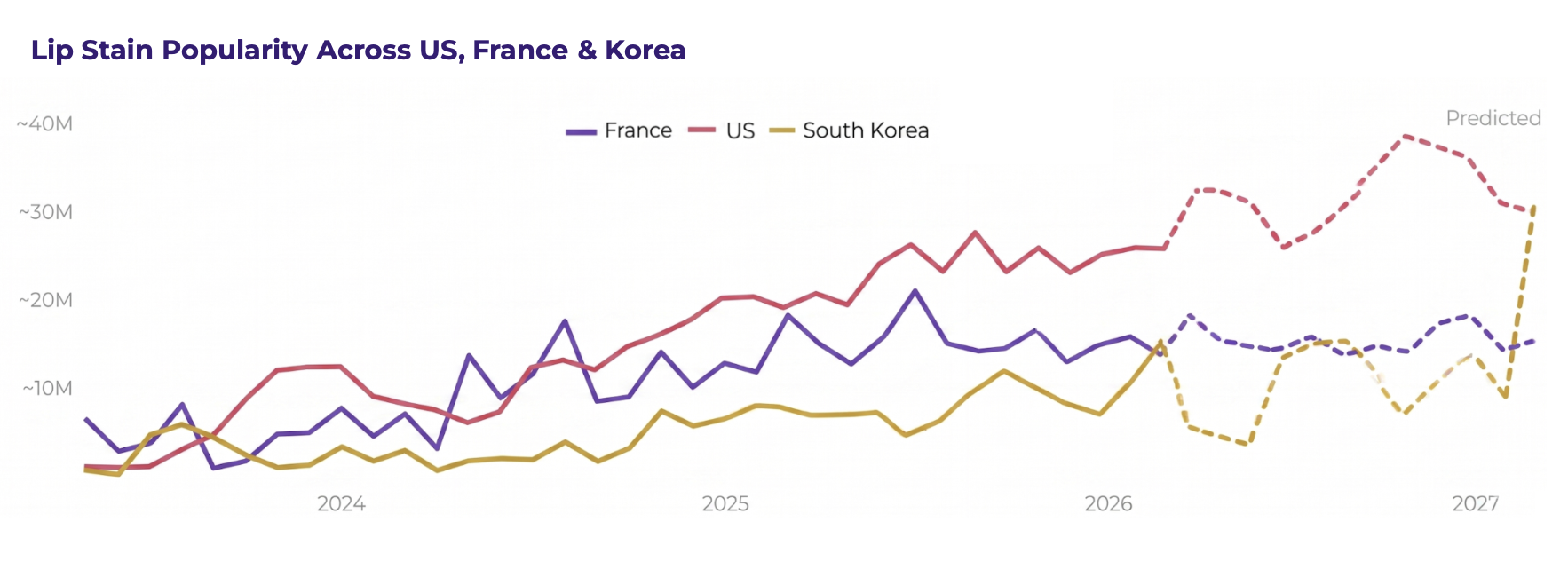 Lip Stain Popularity Index Across the US, France, and South Korea, May 2023 - April 2026. Source: Spate Dashboard.
In South Korea, consumers have effectively been using stains for years; they simply call them “tints.” This distinction matters. Lip tints in South Korea hold Very High Popularity and are already deeply established among consumers, while lip stains sit at Medium Popularity, with +174.5% year-over-year expansion signaling rapid movement toward mainstream adoption. Daniella Jung explains that lip tints in South Korea function more as an everyday wear item, commonly used for school, work, and even during workouts, often simply to add a natural flush of color and make the face look more alive without feeling heavy or overdone, reflecting one of the key principles of Korean makeup: natural-looking beauty, or “looking put together without looking like you tried.” As lip stain continues to grow, TikTok has become the dominant space of discovery with 88.3% popularity share and +183.7% year-over-year growth, with #aprilskin being the main related branded hashtag with 42.5K average weekly views, followed by #peripera with 10.8K, underscoring how local brands are shaping discourse within the category.
The Defined Lip
Lip liner reveals how beauty cultures move between definition and naturalness, a tension that becomes especially visible on TikTok, where lips are repeatedly reframed through close-up video, layered application, and increasingly detailed breakdowns of technique.
In the US, lip liner is arguably having its biggest cultural moment since the 1990s, but the contemporary version is fundamentally different from the sharply drawn brown liners associated with that era. Today’s liner renaissance is not really about the liner itself. It is about how it has become the framework around which the entire lip routine is built. The rise of the “lip combo” transformed liner from a supporting product into the essential first step of a systemized aesthetic ritual. At a market level, lip liner in the US has a Very High Popularity with a steady growth of +36.6% year over year. The top growing related product formats alongside lip liners are lip stains +17.3% YoY growth, and lip crayons with +186.2% YoY.
In France, Lip liner sits at high popularity and continues to maintain momentum with +50.0% year over year growth. Contrary to the US, the top growing product format alongside lip liner is lip pencil with +93.5% year-over-year. TikTok dominates the category conversation with 85.8% popularity share and +86.4% year-over-year growth, demonstrating how heavily social content is shaping the category.
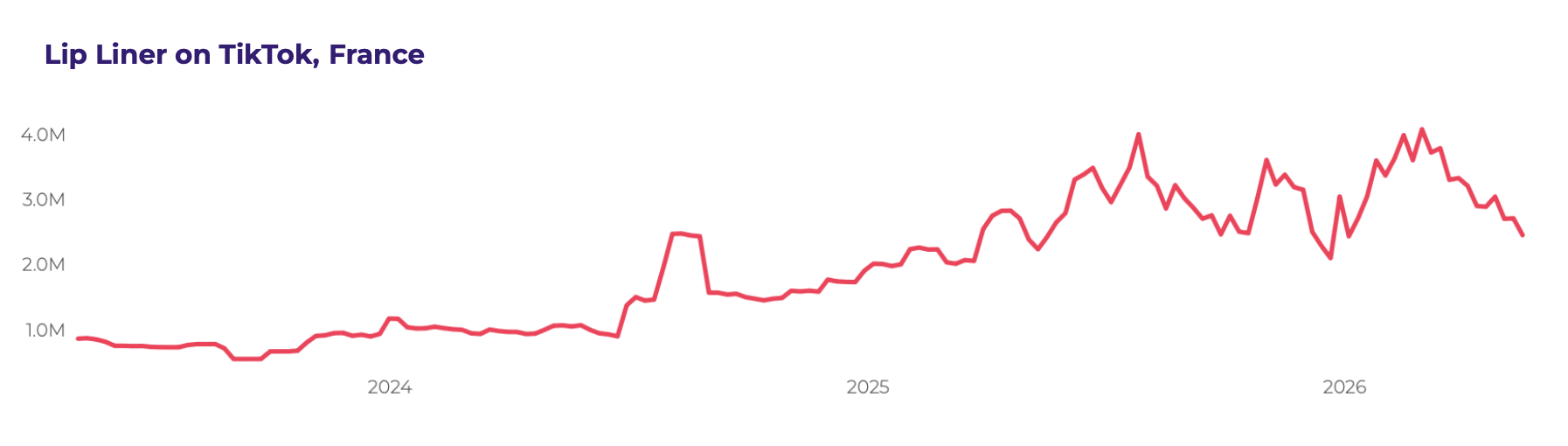 Lip Liner Performance on TikTok FR, May 2023 – May 2026. Source: Spate Dashboard.
South Korea approaches lip liner through the logic of dimensional illusion. For years, lip liners occupied a limited role in South Korean beauty because gradient lips and tint-centered aesthetics did not require sharply defined edges. Today, the category has achieved High Popularity with +48.0% year over year growth, driven primarily by TikTok, who owns 67.5% of the trend’s popularity share. Makeup artist Annie Dayoon Kim explained that South Korean overlining is not about uniformly extending the lip border outward, it is about creating dimension and fullness through shadow placement and strategic blur, where the center appears fuller while the edges remain soft.
From Instant Plump to Lasting Volume
Lastly, there is the category perhaps most revealing of where beauty is heading overall: lip plumpers (and the rise of lip volumizers). For years, lip plumpers occupied a somewhat gimmicky space within beauty, products associated with tingling sensations, temporary swelling, and exaggerated before-and-after marketing. Today, consumers are moving toward something more sophisticated: lip volumizers, topical treatments that address the underlying biology of lip aging and produce volume as a consequence of cellular health, not surface irritation.
In the US, lip plumpers are highly popular and well-established, the category is beginning to fade. However, lip volumizers, sit at Low Popularity and are at the beginning of their growth phase, with over 1,000% year-over-year growth. The volumizer category is increasingly used as a positioning upgrade within the plumper market, signaling longer-term benefit, associated with its active ingredients like hyaluronic acid and collagen, rather than an immediate tingle. Both lip plumper and lip volumizer are owned by TikTok in terms of popularity share, at 68.6% and 59.3% respectively, highlighting the platform's role as the primary engine for discovery.
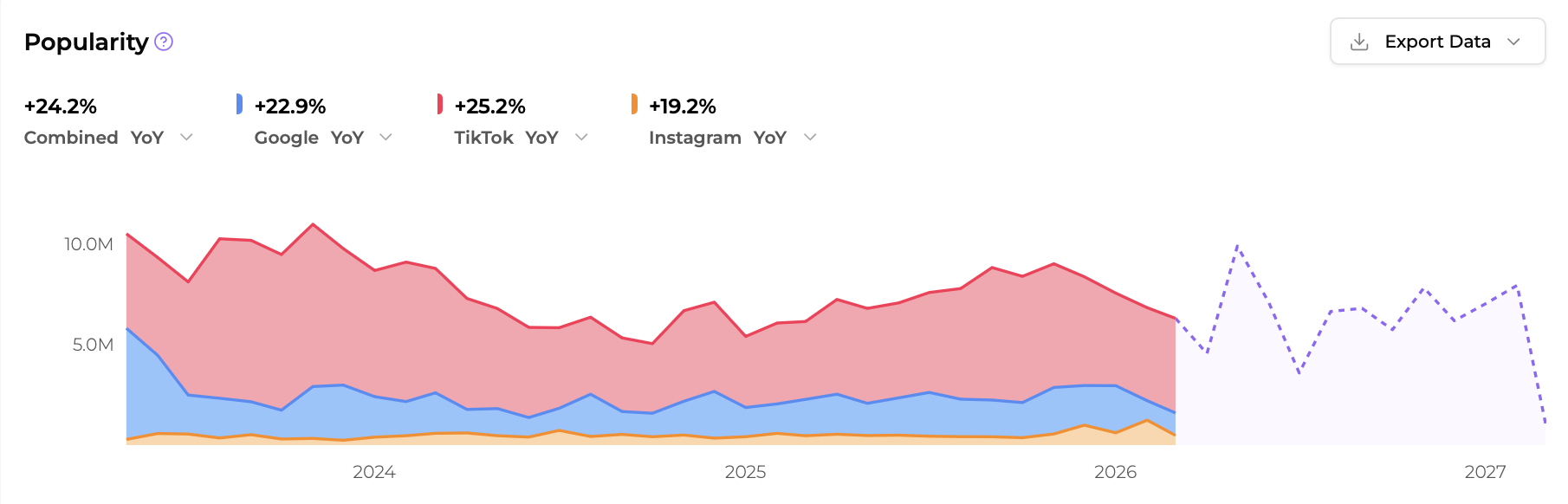 Lip Plumper Popularity Index in the US, May 2023 – April 2026. Source: Spate Dashboard.
Similar to the US, lip plumper is a High Popularity trend with +18.0% year-over-year growth in France, but is showing signs of fading as momentum begins to slow down. In contrast, lip volumizer has a Medium Popularity and is rapidly accelerating, with over 1,000% year-over-year growth, indicating that while it is fairly well known to consumers, it continues to grow rapidly. The primary difference between lip plumper and lip volumizer lies in their formulation approach and long-term results: volumizers use a higher concentration of clinical peptides and "filling spheres" specifically designed to mimic the results of injectable fillers. Notably, #rocskincare currently dominates the lip volumizer conversation on TikTok in both the US and France with 19.4K avg. weekly views and 1.4K, respectively.
In South Korea, lip plumper is a High Popularity trend and continues to expand at +31.3% year-over-year growth, reflecting a well-established beauty behavior that is still gaining traction. TikTok accounts for 50.0% of the trend’s popularity share, showing that discovery and engagement are pretty evenly split between social-driven exposure and search and intent-based behavior. The branded conversation in South Korea is led by #vtcosmetics on TikTok, with 716.3K average weekly views, driven by the visibility of VT Cosmetics’ Reedle Shot Lip Plumper. The product uses “Cica Reedle” technology combined with hyaluronic acid, jojoba oil, and Jimo Root to deliver what the brand describes as “instant volume,” achieved through controlled physical micro-stimulation alongside deep hydration. Rather than relying on traditional irritant-based plumping mechanisms, the effect is positioned as a skin-conditioning process, where visible fullness is created through improved lip texture and moisture retention.
To explore more makeup data across the US, France, and South Korea, join Spate at MakeUp in Paris on June 17–18, 2026, where we will present "The Future of Makeup: Signals, Shifts & the Next Wave Across the US, France & Korea."
For a deeper look at how you can leverage the Spate dashboard to track consumer behavior across markets, book your free trial.
